.jpg)


Case Study: Heinz Debuts Fry Box with Built-in Ketchup Dipper
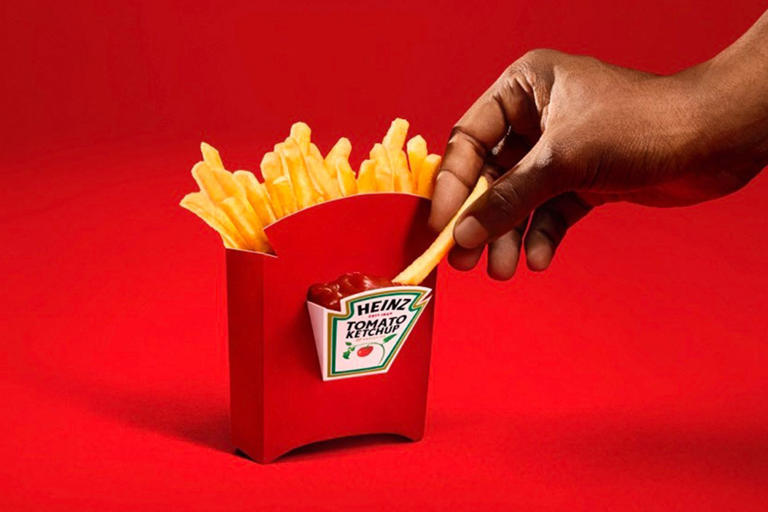
Packaging innovation is often the invisible driver of brand growth. While the majority of legacy brands fixate on the product inside, obsessing over flavor profiles, portion sizes and the price points, the true market leaders realize that the product is only as good as the user’s ability to access it.
For Heinz, the landmark breakthrough of 2026 wasn't a new sauce, but it was a fundamental reengineering of the interface. By debuting the Heinz Dipper fry box with a builtin ketchup compartment the brand solved a functional friction that had plagued the QSR (Quick Service Restaurant) industry for over 75 years. This represents a strategic use of structural innovation, turning a known consumer pain point into a competitive advantage.
More to explore: How Customisation In Rigid Plastic Packaging Helps Build Stronger Brands?
Research conducted by Heinz revealed a significant operational loss, roughly 80% of consumers reported skipping condiments entirely when eating on the go. The reason is a logistical failure as handling flimsy packets while walking, commuting or driving feels too difficult.
For a brand that leads the condiment category, that represents an 80% loss in potential consumption opportunities. When a consumer skips the sauce to avoid a mess, the brand loses its primary touchpoint. The Dipper reservoir actually transforms the fry box from a passive container into an active dipping station. By integrating a patent pending flap that pulls out to create a stabilized sauce reservoir, Heinz dismantled three major functional barriers:
Surface Independence: In today’s world, the table is often a lap or a dashboard. The dipper mostly eliminates the need for a flat surface to balance open sauce packets.
Mess Mitigation: With around 70% reported spill rate for on the go snacking, the structural stability of the reservoir helps to create a deep splash resistant zone that secures the product during movement.
Geometric Guidance: The design mostly utilizes the iconic keystone silhouette as a functional structural cutout, by leveraging familiar brand geometry to intuitively direct the user to the primary interaction point
The Innovation Dividend of Strategic Gains

Most packaging innovations fail not because the consumer hates them, but because the operator does. In high velocity QSR environments, if a structural modification adds even 1.5 seconds to the assembly time or creates friction during the de-nesting process (separating units from a stack), the design will be rejected by franchisees.
The Heinz Dipper succeeds because it prioritizes Runnability:
Standard Footprint: It fits into existing fry-scoop stations without modification.
Nesting Capability: The boxes stack with the same density as traditional designs, preserving storage space.
Tapered Geometry:The reservoir flap is flush mounted, ensuring the boxes maintain a smooth exterior profile that prevents snagging or bricking (vacuum-locking or interlocking of units) during high speed distribution and peak service hours.
By ensuring the box works harder for the consumer without making the operator work harder, Heinz successfully moved from a prototype to a global trial across 11 countries.
Material Engineering- Sustainability and Stability
Beyond convenience, the Dipper addresses the waste gap. Traditional ketchup packets are difficult to recycle and frequently end up as litter. By moving the sauce vehicle directly into the FSC certified paperboard fry box, Heinz enables a monomaterial waste stream. This makes it easier for consumers to dispose of the entire meal packaging in a single recycling bin.
Also, the structural integrity is always maintained through material science. The reservoir utilizes a food grade, aqueous coating that protects against moisture. This prevents the wicking effect, where vinegar or oils soften the paperboard ensuring the box remains rigid until the meal is finished.
Conclusion: Innovation as a Performance Tool
The Heinz Dipper proves to be a masterclass in using packaging to solve a Usage Gap. It proves that you don't always need any digital gimmick to innovate. Sometimes, you just need to rethink the architecture of the container to better serve the human hand.
When structural engineering is used to address real world behavior, the result is more than just a box, but it’s a performance tool that drives volume and reduces friction. It shows that when packaging works intuitively, it doesn't just hold the product but sells it.
Frequently Asked Questions
1. How does this innovation help brand growth? By making on the go dipping easier, Heinz recaptures the market share of the people who used to skip the condiments. It reinforces the brand’s position as a solution provider, not just a sauce manufacturer.
2. Is this more expensive to manufacture? While custom tooling is mostly required to die cut the use of standard carton board keeps material costs stabilised. The innovation dividend comes usually from the increased brand visibility and higher condiment volume, which offsets the initial engineering investment.
3. Does the builtin dipper work for other sauces? Yes, while designed for ketchup, the reservoir is engineered for high viscosity fluids. The structural reinforcement ensures it can support the weight of various dips (mayonnaise, mustard, BBQ) without the box sagging or moisture wicking into the board.